
The Power of Peace Circles


Credit: Cliff Grassmick/Digital First Media/Boulder Daily Camera via Getty Images
With so many crises unfolding around the world and lingering tensions even on our island, it often feels as though conflict is inescapable. We find ourselves polarized, divided by issues large and small—each side convinced it holds the only valid perspective. Yet, when we pause to listen truly and speak genuinely, we unlock the power of understanding and reconciliation. One simple but profound way to foster meaningful dialogue is through Peace Circles.
Although many people associate these circles with restorative justice in criminal cases, they can also be used to address conflicts or challenges of all shapes and sizes—from disagreements in community groups to sensitive family matters. On Mayne Island, where we value connectedness and cooperation, this approach can be a remarkable tool to ensure all voices are heard and our seniors continue to thrive among us.
Understanding Peace Circles
Peace Circles derive their structure from the core belief that everyone has something valuable to share, and that open, equitable dialogue can help resolve even the toughest issues. Participants gather in a circular formation, physically placing everyone on the same level—no one stands at the head of the table, and no single person is singled out. This physical arrangement underscores that every person’s voice is equally important. In a setting where we face each other directly, empathy and respect can flow more naturally. The simplicity of the circle is symbolic of unity, reminding us that solutions often arise from shared responsibility, not top-down instruction.
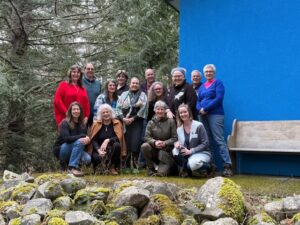
An Indigenous Tradition of Listening
It’s widely acknowledged that the concept of passing a “talking piece” in a circle is rooted in Indigenous practices. Many First Nations cultures have long used a Talking Stick or similar object to guide respectful, heart-centered dialogue in communities. The one holding the talking piece speaks, while others listen without interruption. This process safeguards each speaker’s perspective, prevents arguments from spiraling, and encourages everyone to be thoughtful about their words. Today, Peace Circles honour that tradition by upholding the same core values of respect, equality, and holistic listening. By recognizing these roots, we acknowledge that we owe a debt of gratitude to Indigenous communities for sharing a format that can heal and unite us.
Fostering Community
On Mayne Island, we pride ourselves on strong community bonds and a commitment to helping one another—especially our elders. But we don’t have to look too far in the recent past where well-intentioned discussions got tangled in differing opinions or conflicts that lead lasting trails.
Peace Circles offer a gentle yet powerful way to navigate these critical conversations. By ensuring that people involved or affected have equitable speaking time, we can uncover common ground, clarify misunderstandings, and craft creative solutions.
A Path Toward Shared Understanding
Whether we’re grappling with global-scale strife or the everyday challenges of living in a tight-knit community, communication remains the key to bridging our differences. Peace Circles are a timeless, flexible tool for fostering genuine dialogue. Their potential extends far beyond restorative justice—they can help us talk more openly about aging in place, environmental stewardship, community projects, or any issue that needs careful, inclusive conversation. By sitting in a circle and passing a small object from hand to hand, we reclaim the power of real communication and remind one another of our shared humanity. In a world that can feel increasingly fragmented, a simple circle might be just the place to mend divisions and build a healthier, more caring Mayne Island for generations to come. For support and education about facilitating Peace Circles, contact cjp@sginh.ca.
Jean-Daniel Cusin
Mayne Island Collective
Responses