
Do We Have a Water Problem?

A recent Facebook rant about illegal Airbnbs and how vacationers disregard the island’s limited water access reminded me of an insightful Islands Trust webinar, 2024 Groundwater: Our Shared Responsibility. You can find it under the Stewardship Education section of their website, and it’s definitely worth a listen.
Now, imagine living on an island about two and a half times the size of Mayne Island, with a population of around 64,000 people, where there are no wells. Welcome to Bermuda. Their secret? Rainwater catchment and storage. They don’t rely on wells because of the same issue many of us face: saltwater intrusion, which occurs when wells are overdrawn, pulling in seawater.
Here on Mayne Island, over 98% of the rain that falls ends up flowing straight into the ocean, leaving only 2% to recharge our aquifers and supply our wells. So, we don’t necessarily have a water shortage problem—what we really have is a storage problem.
Contrary to a myth you might have heard, the water on Mayne Island doesn’t flow from Mount Baker. There’s no magical pipeline supplying us with fresh water from the mainland. All our water comes from the rain that falls directly on the island.
Another common misconception is that aquifers are vast underground lakes or rivers from which we can easily extract water. The reality is that aquifers are layers of rock, sand, or gravel that store water in small spaces between particles or fractures in the rock. For example, on Mayne Island, many aquifers are fractured bedrock, meaning water is stored in tiny cracks and fissures. As a result, these aquifers don’t hold water uniformly, and two wells drilled just a short distance apart can have vastly different water yields.
Our aquifers serve as storage tanks, but as many residents discover during the summer, they often fall short. Hence the steady stream of water trucks coming off the ferry in the hotter months. Fortunately, there are things we can do to help recharge our aquifers.
Preserving natural vegetation is one of the best ways to do this. Forests and wetlands act like sponges, absorbing rainwater and slowly releasing it into the ground. If you have natural vegetation on your property, protect it! You might also consider planting native species with deep root systems that help water percolate into the soil, rather than allowing it to run off into ditches or streams. The Mayne Island Conservancy can help you with that.
You can also redirect rainwater on your property to areas where it can infiltrate the soil. Rain gardens or French drains are great solutions to capture runoff and promote groundwater recharge.
Conserving water is another simple but impactful step. Fix leaks, install low-flow fixtures, and consider using greywater—such as water from sinks, showers, and laundry—for irrigation. Every drop saved reduces the pressure on our groundwater supply, particularly during the dry summer months.
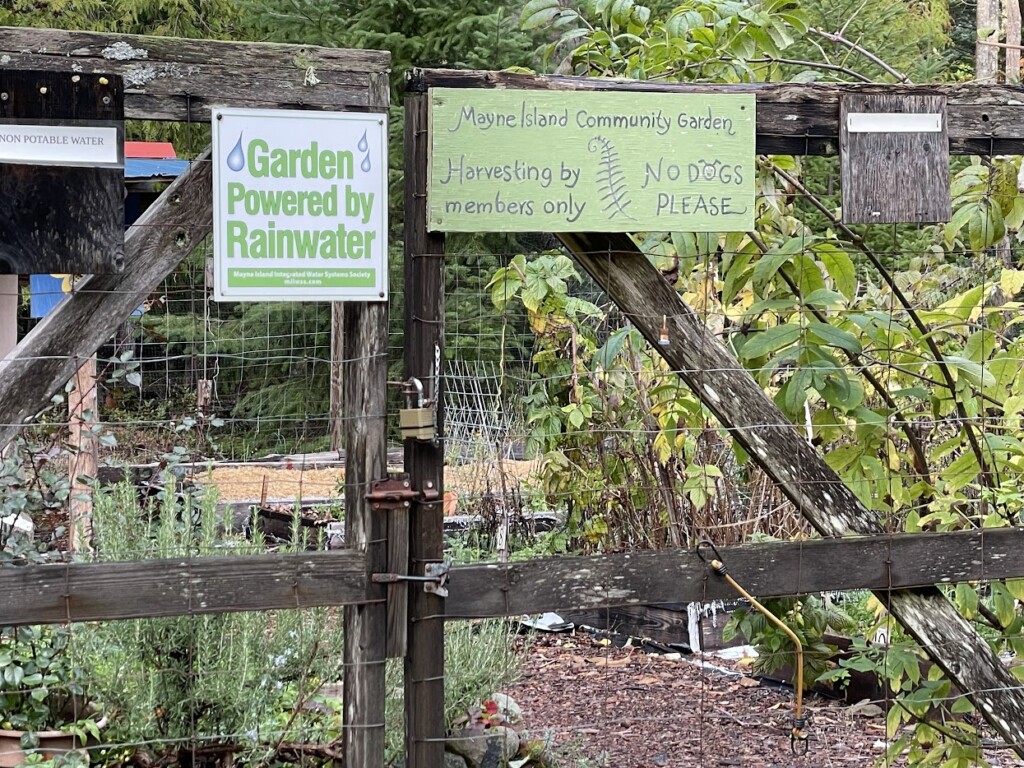
If you want more control over your water availability, consider installing a rainwater catchment system, such as rain barrels or cisterns, to collect runoff from your roof. This stored water can be used for irrigation or other non-potable needs, reducing the demand on your well. Slow-release systems can also help by allowing stored water to gradually seep into the ground, mimicking natural recharge processes.
With climate change and increasing water demand, it’s more important than ever to manage our precious groundwater resources wisely. Every small effort adds up.
This brings us back to the Airbnb situation. When vacationers flock to Mayne Island, especially during the dry summer months, it’s easy for them to overlook how limited our water supply truly is. Just as Bermuda has adapted by using rainwater catchment systems to ensure their residents—and visitors—have water year-round, we too must think sustainably. If an island as densely populated as Bermuda can make every drop of rainwater count, we should be able to do the same.
Encouraging Airbnb hosts to educate their guests about our water limitations, perhaps even equipping homes with small-scale rainwater collection systems, would be a significant step forward. It’s not just about enforcing regulations—it’s about fostering the same awareness and responsibility that sustains an island of 64,000 people with no wells.
So, whether you’re a resident or a visitor, remember: every drop of rain matters. On Mayne Island, just like in Bermuda, managing our water isn’t just a choice—it’s a shared responsibility.
Jean-Daniel Cusin
The Mayne Island Collective
maynesynergy@gmail.com
Responses